Off-sample scorecard
1MD BiomeMD: ingredients and label score
1MD Nutrition scored 1 out of 6 for label disclosure under methodology
v1.17, read from the label as captured on 2026-11-19. The full ingredient
list from the Supplement Facts panel is below the score.
Outside the sample. This product is not in the captured Amazon ranking the pilot was drawn from, so its row is kept in a separate file and is counted in no ranking, mean or “products scored” figure on this site. It is scored on the identical six criteria, by the same rules, from the same dated-capture evidence.
Disclosure Facts
1MD BiomeMD1MD Nutrition · label captured 2026-11-19
Disclosure score1/6
- 1. Exact amount for every active ingredient0 ✗
- 2. Standardization percentage stated0 ✗
- 3. Chemical form or strain named0 ✗
- 4. Dose within the trial range0 ✗
- 5. Certificate of analysis is public0 ✗
- 6. Per-serving amounts are complete1 ✓
Each criterion scores 1 or 0. No weighting, no partial credit.
1MD BiomeMD ingredients
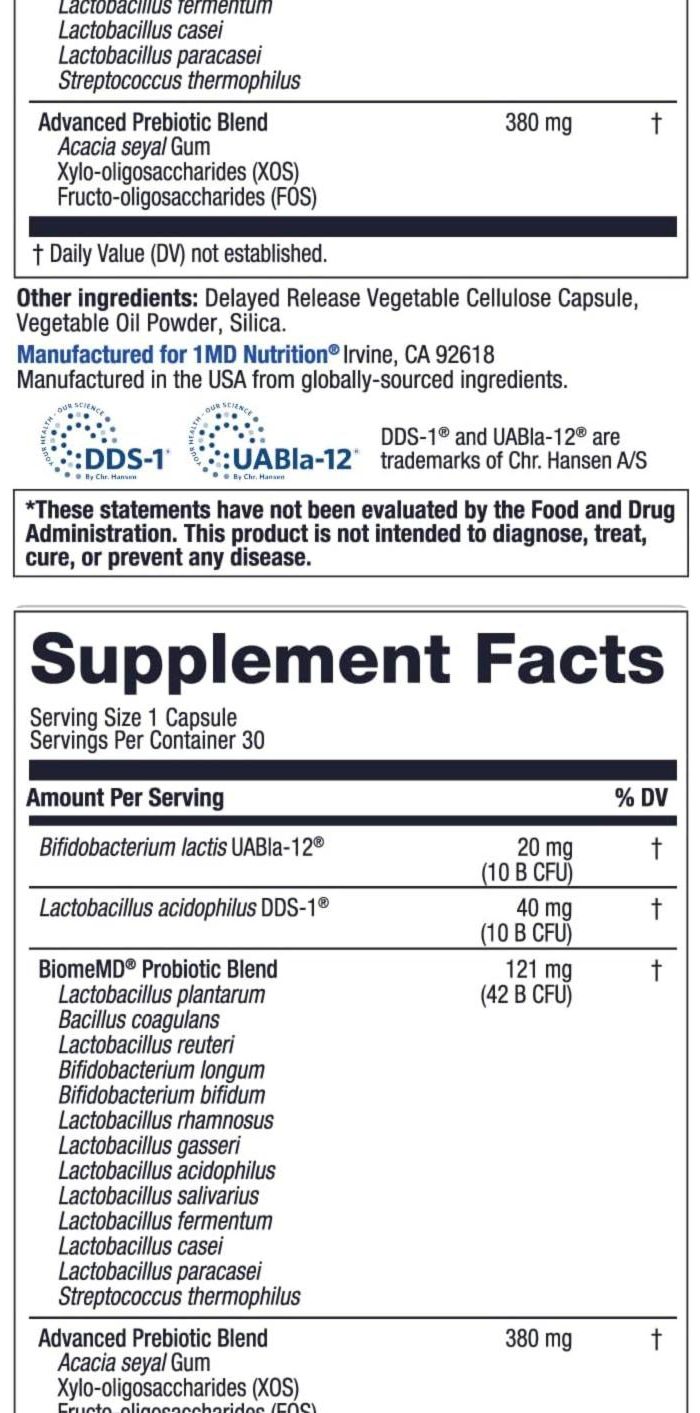
Every line of the Supplement Facts panel, as printed on the label captured 2026-11-19, typed out so
it can be read without opening the image. Amounts are per serving. The panel capture is the
record; where the capture cuts a line off, the table says so rather than filling it in.
Serving size: 1 Capsule ·
Servings per container: 30
| Ingredient | Per serving | %DV |
|---|
| Bifidobacterium lactis UABla-12® | 20 mg (10 B CFU) | not established |
| Lactobacillus acidophilus DDS-1® | 40 mg (10 B CFU) | not established |
BiomeMD® Probiotic Blend
Lactobacillus plantarum, Bacillus coagulans, Lactobacillus reuteri, Bifidobacterium longum, Bifidobacterium bifidum, Lactobacillus rhamnosus, Lactobacillus gasseri, Lactobacillus acidophilus, Lactobacillus salivarius, Lactobacillus fermentum, Lactobacillus casei, Lactobacillus paracasei, Streptococcus thermophilus | 121 mg (42 B CFU) | not established |
Advanced Prebiotic Blend
Acacia seyal Gum, Xylo-oligosaccharides (XOS), Fructo-oligosaccharides (FOS) | 380 mg | not established |
Other ingredients. Delayed Release Vegetable Cellulose Capsule, Vegetable Oil Powder, Silica.
Why it scored this way
Off-sample row under methodology v1.14, Amazon listing B07WC3ZVF7 (30ct). Not in the 09/26/2026 captured ranking; added 2026-11-19 because searches reaching this site ask whether BiomeMD is third-party tested. Panel: Serving Size 1 Capsule, Servings Per Container 30; Bifidobacterium lactis UABla-12 20 mg (10 B CFU); Lactobacillus acidophilus DDS-1 40 mg (10 B CFU); BiomeMD Probiotic Blend 121 mg (42 B CFU) listing 13 organisms; Advanced Prebiotic Blend 380 mg (Acacia seyal Gum, Xylo-oligosaccharides (XOS), Fructo-oligosaccharides (FOS)).
0
1. Exact amount for every active ingredientTwo blends. The BiomeMD Probiotic Blend gives a 121 mg total for 13 organisms with no per-organism amount, and the Advanced Prebiotic Blend gives a 380 mg total for three fibers with no per-fiber amount. UABla-12 and DDS-1 are the only actives with their own amounts.
0
2. Standardization percentage statedXOS is sold at graded purities and its reference range is expressed as XOS, so a percentage is potency-determining under the functional test; here neither the percentage nor even an XOS weight is disclosed, since it sits inside a blend total. Scored consistently with BIOMA, Lemme Debloat and Garden of Life Men.
0
3. Chemical form or strain namedThe 13 organisms in the BiomeMD Probiotic Blend are named to genus and species only (Lactobacillus plantarum, Bacillus coagulans and so on). UABla-12 and DDS-1 carry strain designations, but one undesignated organism is enough to score 0 under v1.6.
0
4. Dose within the trial rangeOn the fibers alone. The Advanced Prebiotic Blend is 380 mg in total, so even if all of it were XOS it would sit below the 1.4 g/day low end of the XOS range, and even if all of it were FOS it would be under a tenth of the 5 g/day FOS range: the same upper-bound test applied to Physician's CHOICE's 150 mg prebiotic blend. The probiotics give no point back. The 13 blended organisms cannot be compared to any trial dose under the attribution rule. UABla-12 and DDS-1 are declared both in milligrams and in CFU. The milligram figures cannot be used under v1.12: the human trial located for these strains at a digestive outcome, Martoni 2020 (PMID 32019158, randomised double-blind placebo-controlled, 330 adults with IBS, conducted with the strain supplier UAS Laboratories, so the weaker basis under the independence rule), doses in CFU, not milligrams of preparation: 1 x 10^10 CFU/day per strain (Martoni 2020 full text, mdpi.com), the same figure as the label's unqualified 10 billion CFU, so the 0 rests on the v1.13 rule that an unqualified count does not establish a delivered dose. Its introduction cites earlier trials of the same strains in functional constipation and lactose intolerance; those were not reviewed for this row, which is recorded as a limit of the search (PubMed 'Lactobacillus acidophilus DDS-1 irritable bowel randomized', 2026-11-19, 2 records). The CFU figures carry no through-expiry guarantee anywhere on the panel, so under v1.13 the delivered dose cannot be established and criterion 4 scores 0 on both ingredients.
0
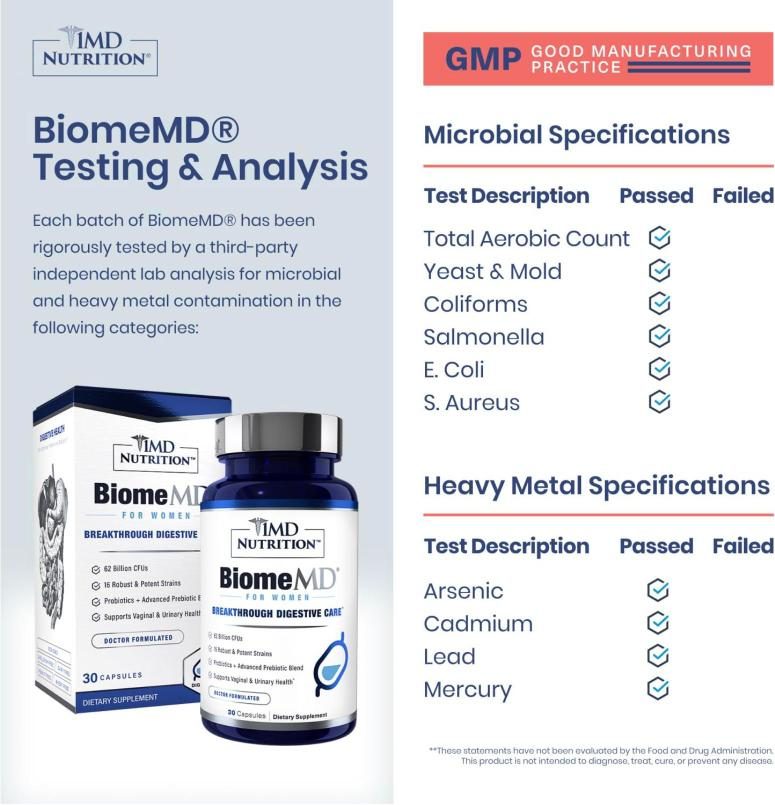
5. Certificate of analysis is publicNo publicly accessible third-party certificate of analysis located 2026-11-19 (Amazon listing and its images, 1md.org/products/biomemd, 1md.org site search, site-scoped and open web search). Listing image 3 is a 'Testing & Analysis' graphic claiming third-party batch testing with pass ticks and no laboratory, lot or document, excluded as a testing claim; the bottle it shows is labelled BiomeMD for Women, a different product with a different panel. Recorded as a negative finding, not a claim that none exists.
1
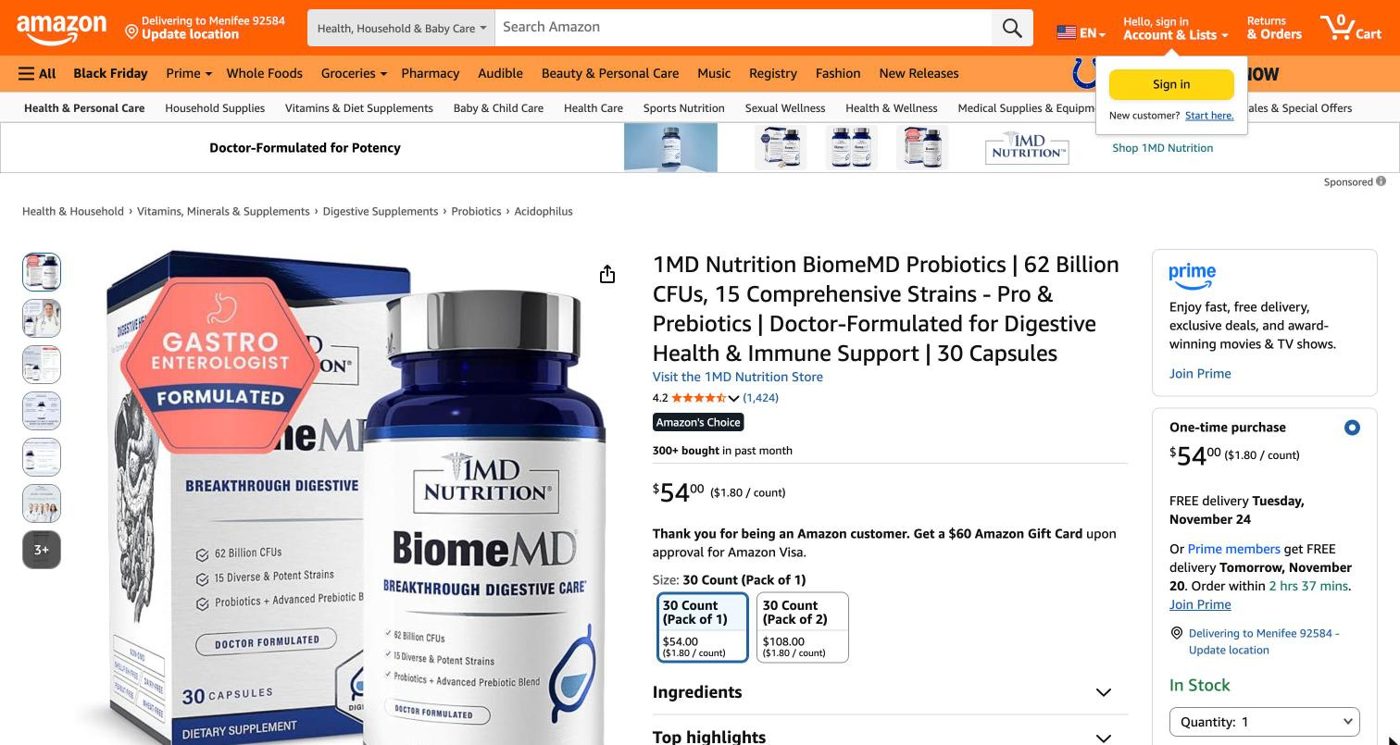
6. Per-serving amounts are completeServing size 1 capsule and servings per container 30 are both printed on the panel. Panel: captures/1md-biomemd-panel-2026-11-19.png Listing: captures/1md-biomemd-listing-2026-11-19.png Testing image: captures/1md-biomemd-testing-image-2026-11-19.png
Questions about this label
What are the ingredients in 1MD BiomeMD?Per the Supplement Facts panel captured 2026-11-19, one serving (1 Capsule) lists: Bifidobacterium lactis UABla-12® (20 mg (10 B CFU)); Lactobacillus acidophilus DDS-1® (40 mg (10 B CFU)); BiomeMD® Probiotic Blend (121 mg (42 B CFU)): Lactobacillus plantarum, Bacillus coagulans, Lactobacillus reuteri, Bifidobacterium longum, Bifidobacterium bifidum, Lactobacillus rhamnosus, Lactobacillus gasseri, Lactobacillus acidophilus, Lactobacillus salivarius, Lactobacillus fermentum, Lactobacillus casei, Lactobacillus paracasei, Streptococcus thermophilus; Advanced Prebiotic Blend (380 mg): Acacia seyal Gum, Xylo-oligosaccharides (XOS), Fructo-oligosaccharides (FOS). Other ingredients: Delayed Release Vegetable Cellulose Capsule, Vegetable Oil Powder, Silica.
Does the 1MD BiomeMD label give an exact amount for every ingredient?No. At least one active ingredient is listed without its own amount, for example inside a blend total, so it scored 0 on criterion 1. Two blends. The BiomeMD Probiotic Blend gives a 121 mg total for 13 organisms with no per-organism amount, and the Advanced Prebiotic Blend gives a 380 mg total for three fibers with no per-fiber amount. UABla-12 and DDS-1 are the only actives with their own amounts.
Is 1MD BiomeMD third-party tested?This audit checks one thing here: whether a third-party certificate of analysis (COA) for the product can be reached by the public, with no email gate and no account. None was located, so it scored 0 on criterion 5. That records what a documented search found, not a claim that the product was never tested. No publicly accessible third-party certificate of analysis located 2026-11-19 (Amazon listing and its images, 1md.org/products/biomemd, 1md.org site search, site-scoped and open web search). Listing image 3 is a 'Testing & Analysis' graphic claiming third-party batch testing with pass ticks and no laboratory, lot or document, excluded as a testing claim; the bottle it shows is labelled BiomeMD for Women, a different product with a different panel. Recorded as a negative finding, not a claim that none exists.
Are the doses in 1MD BiomeMD backed by clinical trials?It scored 0 on criterion 4: no disclosed dose could be shown to fall inside the range human trials used. On the fibers alone. The Advanced Prebiotic Blend is 380 mg in total, so even if all of it were XOS it would sit below the 1.4 g/day low end of the XOS range, and even if all of it were FOS it would be under a tenth of the 5 g/day FOS range: the same upper-bound test applied to Physician's CHOICE's 150 mg prebiotic blend. The probiotics give no point back. The 13 blended organisms cannot be compared to any trial dose under the attribution rule. UABla-12 and DDS-1 are declared both in milligrams and in CFU. The milligram figures cannot be used under v1.12: the human trial located for these strains at a digestive outcome, Martoni 2020 (PMID 32019158, randomised double-blind placebo-controlled, 330 adults with IBS, conducted with the strain supplier UAS Laboratories, so the weaker basis under the independence rule), doses in CFU, not milligrams of preparation: 1 x 10^10 CFU/day per strain (Martoni 2020 full text, mdpi.com), the same figure as the label's unqualified 10 billion CFU, so the 0 rests on the v1.13 rule that an unqualified count does not establish a delivered dose. Its introduction cites earlier trials of the same strains in functional constipation and lactose intolerance; those were not reviewed for this row, which is recorded as a limit of the search (PubMed 'Lactobacillus acidophilus DDS-1 irritable bowel randomized', 2026-11-19, 2 records). The CFU figures carry no through-expiry guarantee anywhere on the panel, so under v1.13 the delivered dose cannot be established and criterion 4 scores 0 on both ingredients.
The evidence
Scores are read from the live label, captured by screenshot on the date shown. A score describes
what the label discloses. It says nothing about whether the product works, and nothing here was lab-tested.
See this row in the dataset →