Off-sample scorecard
Ritual Synbiotic+
Ritual scored 4 out of 6 for label disclosure under methodology
v1.14, read from the label as captured on 2026-10-26.
Outside the sample. This product is not in the captured Amazon ranking the pilot was drawn from, so its row is kept in a separate file and is counted in no ranking, mean or “products scored” figure on this site. It is scored on the identical six criteria, by the same rules, from the same dated-capture evidence.
Disclosure Facts
Ritual Synbiotic+Ritual · label captured 2026-10-26
Disclosure score4/6
- 1. Exact amount for every active ingredient0 ✗
- 2. Standardization percentage stated1 ✓
- 3. Chemical form or strain named1 ✓
- 4. Dose within the trial range1 ✓
- 5. Certificate of analysis is public0 ✗
- 6. Per-serving amounts are complete1 ✓
Each criterion scores 1 or 0. No weighting, no partial credit.
Why it scored this way
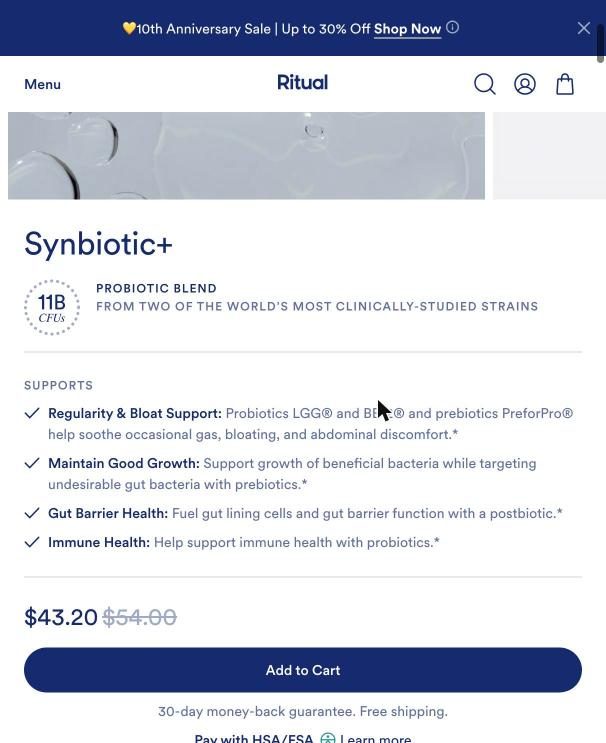
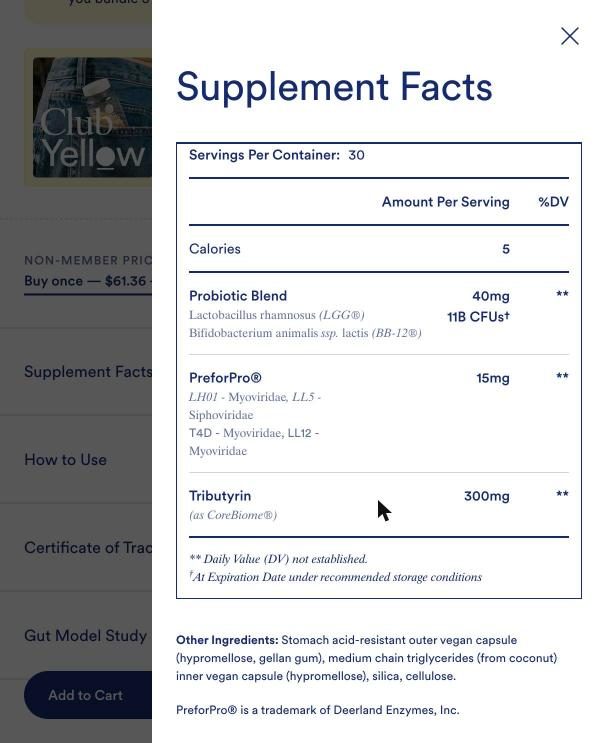
Scored from the live product page at ritual.com/products/synbiotic-plus-for-gut-health, captured 2026-10-26. Panel: Serving Size one vegan capsule, Servings Per Container 30, Calories 5; Probiotic Blend 40 mg (Lactobacillus rhamnosus LGG, Bifidobacterium animalis ssp. lactis BB-12) at 11 billion CFUs at expiration date; PreforPro 15 mg (LH01-Myoviridae, LL5-Siphoviridae, T4D-Myoviridae, LL12-Myoviridae); Tributyrin 300 mg (as CoreBiome).
0
1. Exact amount for every active ingredient'Probiotic Blend 40 mg' gives a blend total and a single combined 11 billion CFU figure for two organisms with no per-organism amount, and PreforPro 15 mg likewise covers four phage strains with no individual amounts. Scored the same way as Seed DS-01 and Lemme Debloat, whose panels withhold per-organism amounts behind a blend total. Tributyrin at 300 mg does carry an exact amount.
1
2. Standardization percentage statedBy default. Nothing in the formula is standardization-dependent -- the probiotics are live organisms, the phages are declared by strain, and tributyrin is declared as the compound itself at 300 mg rather than as an extract weight, so no percentage is needed to compare the label to a reference range.
1
3. Chemical form or strain namedEvery organism carries a strain designation (L. rhamnosus GG and B. animalis subsp. lactis BB-12), the four bacteriophages are named individually, and the postbiotic is named as tributyrin rather than as butyrate generically.
1
4. Dose within the trial rangeAnd the point is a narrow one. The probiotics are excluded: their only per-organism quantity is a CFU count, and it sits inside a blend total, so neither strain can be matched to a trial dose under the attribution rule. Tributyrin is excluded because the reference table carries no range for it -- re-verified 2026-10-26, when the only PubMed-indexed record added since the 2026-09-07 search was a study protocol with no results (PMID 41248397). That leaves PreforPro, declared at 15 mg, which is exactly the dose given in the only positive-outcome human trial of the cocktail (Febvre 2019, PMID 30897686), so the disclosed dose falls within the range and the criterion scores 1 on the rule that a product scores 0 only where an active with a reference range falls outside it. The objection is recorded openly: that range rests on a single manufacturer-supplied trial with no independent replication, flagged as the weaker basis under the independence rule, and its endpoints are microbiota composition rather than the gas, bloating and abdominal discomfort the listing claims -- the symptom trial of the same cocktail at the same dose improved on placebo as well as on treatment (Gindin 2018, PMID 30157383). A reader could fairly argue the point should not stand, and the call was taken against how this audit has already scored criterion 4 rather than on first impression. Two rows decide it. Bifidobacterium longum 35624 carries a range set by two manufacturer-linked trials, explicitly because no independent positive-outcome trial of that strain exists, and that range is what scored Align Pro Formula 0; a manufacturer-linked range that is good enough to mark a product down is good enough to mark one up, and using it only in the direction that penalises would not be a stricter standard but an inconsistent one. And Seed DS-01 was scored against a pomegranate range drawn from microbiota-modulation and endotoxemia trials while its own listing claims bloating and GI comfort, so a non-symptom endpoint setting the range for a symptom-claiming product is the established treatment here too. The parallel with Florastor holds on the funding question: the trial administering the manufacturer's own branded product was set aside there only because three other trials existed, and the independence rule says in terms that a manufacturer trial sets the range where no independent one does, flagged as the weaker basis. The point therefore stands at 1, flagged, rather than 0. The heaviest active by weight, tributyrin at 300 mg, has no human trial behind it either way.
0
5. Certificate of analysis is publicNo publicly accessible third-party certificate of analysis located 2026-10-26 (product page, the Certificate of Traceability panel on that page, brand site, site-scoped and open web search). The Certificate of Traceability states that every lot is third-party tested for heavy metals, microbes and allergens and lists what is tested for, but publishes no document, no laboratory name, no lot number and no result: it is a testing claim rather than a certificate, excluded on the same basis as a 'third-party tested' badge. The Clean Label Project Purity Award displayed alongside it is a certification mark, excluded as Lemme Debloat's was. Recorded as a negative finding, not a claim that no certificate exists.
1
6. Per-serving amounts are completeServing size, one vegan capsule, and servings per container, 30, are both printed on the panel, with every amount stated per serving. Off-sample row under methodology v1.14: Ritual sells direct and does not appear in the captured Amazon category ranking, so it is scored under the identical rubric but kept out of pilot-scores.csv and out of every ranking, mean and count computed over it. Added because Seed DS-01 Daily Synbiotic, at rank 4 of the captured sample, is the head-to-head a gut-health shopper reaches for most often and Ritual Synbiotic+ is the product on the other side of it; Ritual sells direct and so cannot appear in an Amazon category ranking at all. The 2026-10-26 capture was taken from the live page after the earlier blocked attempt recorded in this row's previous revision.
The evidence
Scores are read from the live label, captured by screenshot on the date shown. A score describes
what the label discloses. It says nothing about whether the product works, and nothing here was lab-tested.
See this row in the dataset →