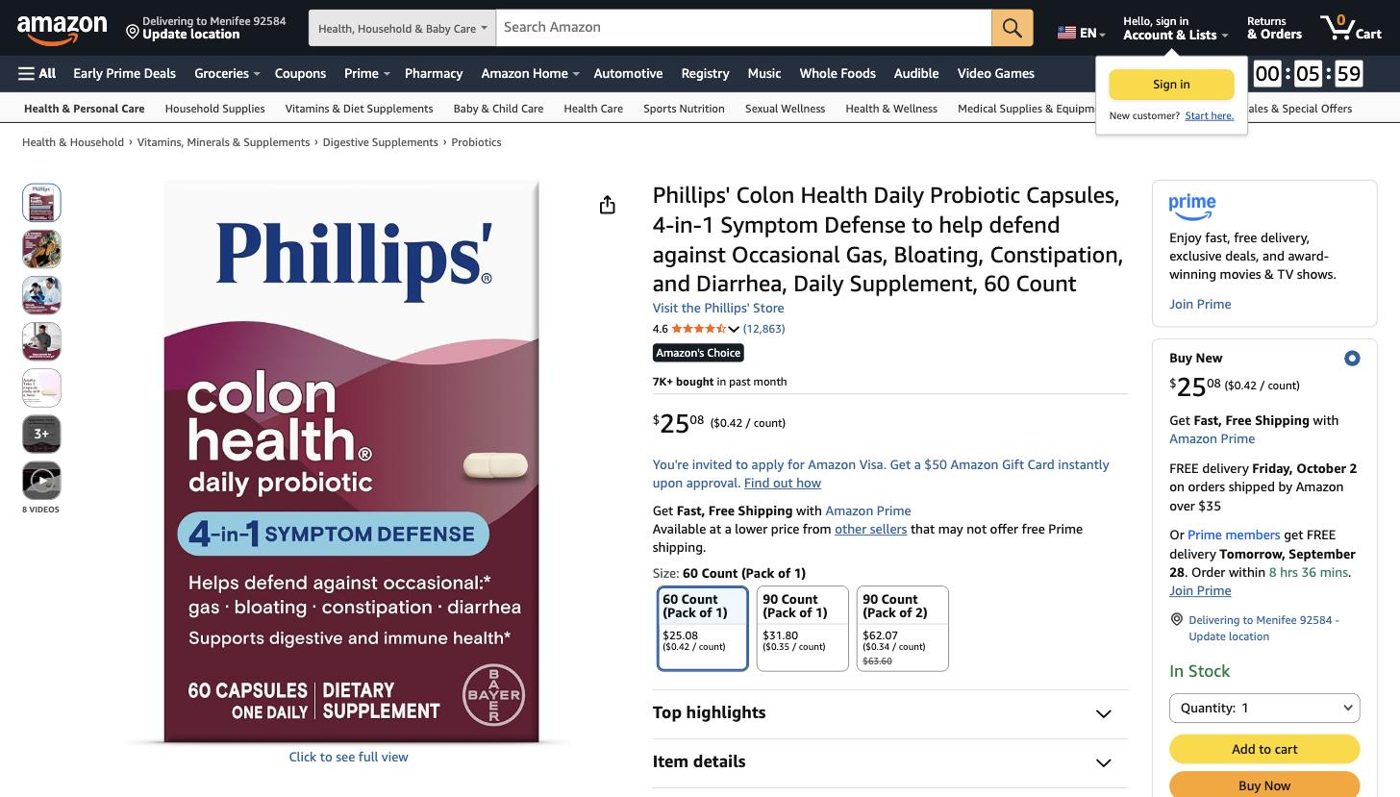
Phillips' Colon Health Daily Probiotic: ingredients and label score
Phillips' scored 2 out of 6 for label disclosure under methodology
v1.17, read from the label as captured on 2026-09-27. The full ingredient
list from the Supplement Facts panel is below the score.
Disclosure Facts
Phillips' Colon Health Daily ProbioticPhillips' · label captured 2026-09-27
Disclosure score2/6
1. Exact amount for every active ingredient0 ✗
2. Standardization percentage stated1 ✓
3. Chemical form or strain named1 ✓
4. Dose within the trial range0 ✗
5. Certificate of analysis is public0 ✗
6. Per-serving amounts are complete0 ✗
Each criterion scores 1 or 0. No weighting, no partial credit.
Phillips' Colon Health Daily Probiotic ingredients
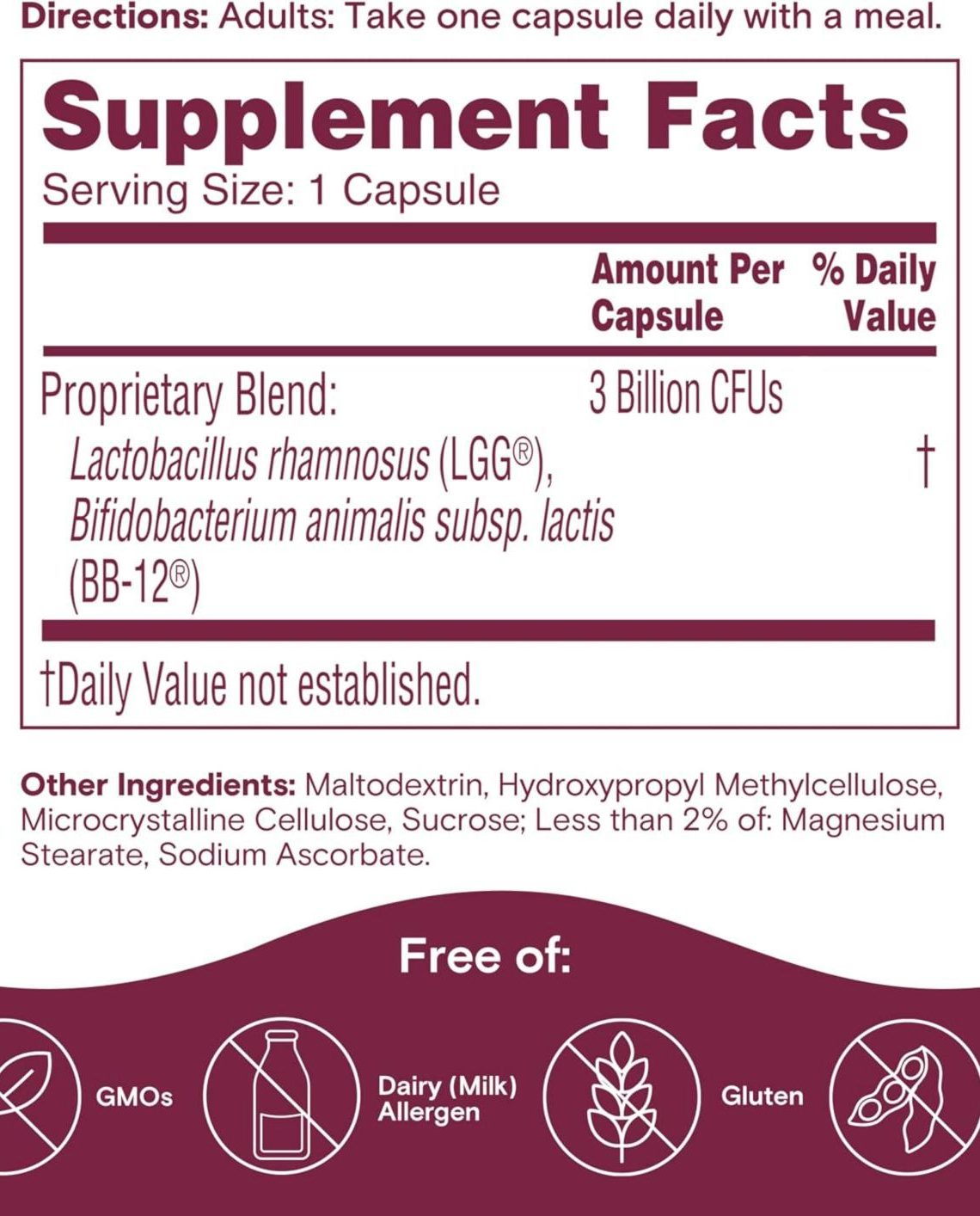
Every line of the Supplement Facts panel, as printed on the label captured 2026-11-19, typed out so
it can be read without opening the image. Amounts are per serving. The panel capture is the
record; where the capture cuts a line off, the table says so rather than filling it in.
Serving size: 1 Capsule ·
Servings per container: not stated on the panel
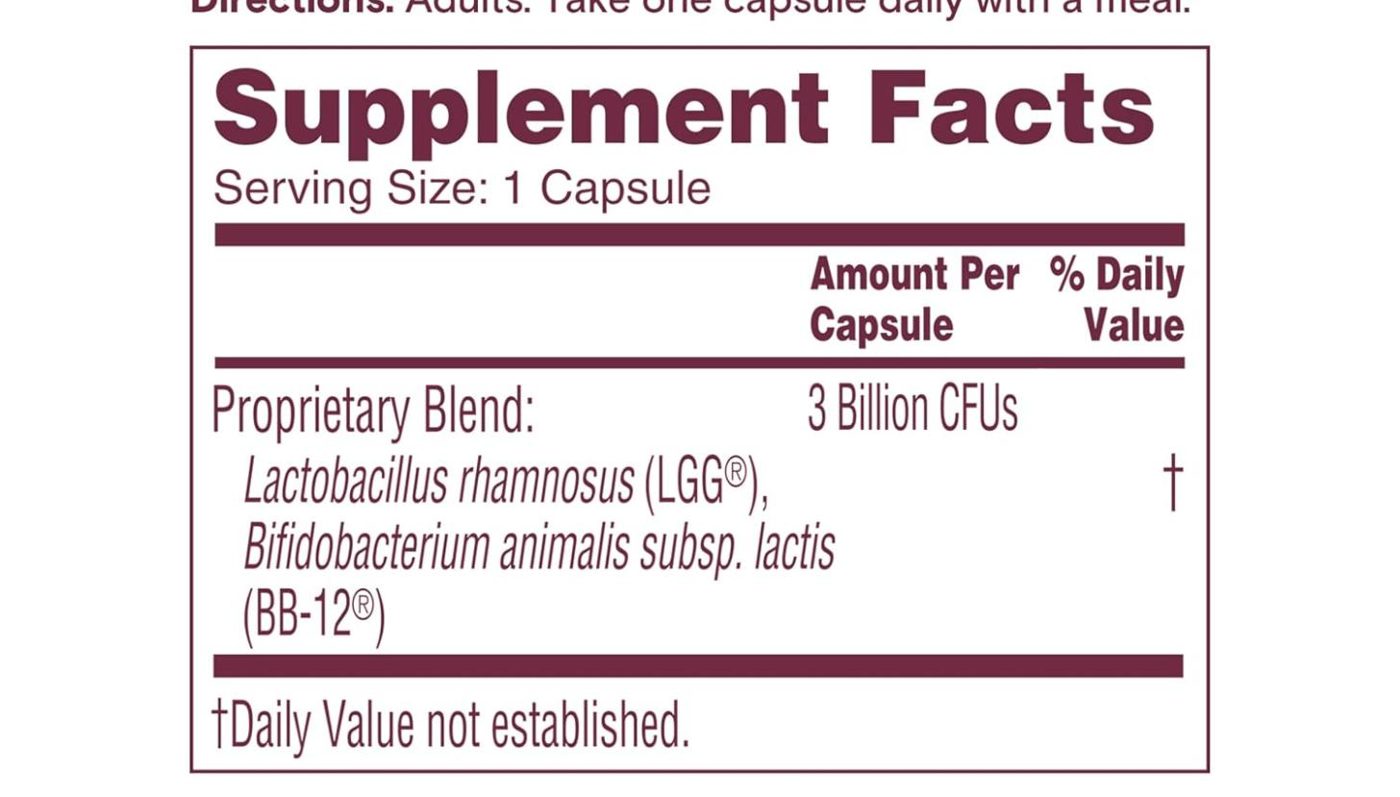
The panel line reads 'Proprietary Blend: 3 Billion CFUs' in those exact words, covering two organisms with no split between them. The most explicit proprietary blend in the sample; most others use a branded blend name instead.
Both organisms carry strain designations, Lactobacillus rhamnosus (LGG) and Bifidobacterium animalis subsp. lactis (BB-12). Two of the best-characterised strains in the probiotic literature, named properly.
The 3 Billion CFU figure is an aggregate across two strains with no split, so neither can be compared to its own trial range under the attribution rule. The point survives even the most generous possible reading: if the entire 3x10^9 CFU were LGG, it would still fall below the 1x10^10 to 2x10^10 CFU/day range verified from Vanderhoof 1999 (PMID 10547243), so no allocation of the blend puts LGG in range. Under v1.13 no through-expiry guarantee and no at-manufacture qualifier appears anywhere on the panel either.
No publicly accessible third-party certificate of analysis located 2026-09-27 (listing images, phillipsdigestive.com, site-scoped and open web search). Recorded as a negative finding, not a claim that none exists.
Serving size 1 capsule is stated but servings per container is absent from the Supplement Facts panel. The carton front reads '60 capsules', which is not the panel. Full-panel re-capture 2026-11-19 (captures/phillips-colon-health-panel-2026-11-19.png), taken because the capture this row was read from is cropped; it matches every line this row relies on.
Questions about this label
What are the ingredients in Phillips' Colon Health Daily Probiotic?
Per the Supplement Facts panel captured 2026-11-19, one serving (1 Capsule) lists: Proprietary Blend (3 Billion CFUs): Lactobacillus rhamnosus (LGG®), Bifidobacterium animalis subsp. lactis (BB-12®). Other ingredients: Maltodextrin, Hydroxypropyl Methylcellulose, Microcrystalline Cellulose, Sucrose; Less than 2% of: Magnesium Stearate, Sodium Ascorbate.
Does the Phillips' Colon Health Daily Probiotic label give an exact amount for every ingredient?
No. At least one active ingredient is listed without its own amount, for example inside a blend total, so it scored 0 on criterion 1. The panel line reads 'Proprietary Blend: 3 Billion CFUs' in those exact words, covering two organisms with no split between them. The most explicit proprietary blend in the sample; most others use a branded blend name instead.
Is Phillips' Colon Health Daily Probiotic third-party tested?
This audit checks one thing here: whether a third-party certificate of analysis (COA) for the product can be reached by the public, with no email gate and no account. None was located, so it scored 0 on criterion 5. That records what a documented search found, not a claim that the product was never tested. No publicly accessible third-party certificate of analysis located 2026-09-27 (listing images, phillipsdigestive.com, site-scoped and open web search). Recorded as a negative finding, not a claim that none exists.
Are the doses in Phillips' Colon Health Daily Probiotic backed by clinical trials?
It scored 0 on criterion 4: no disclosed dose could be shown to fall inside the range human trials used. The 3 Billion CFU figure is an aggregate across two strains with no split, so neither can be compared to its own trial range under the attribution rule. The point survives even the most generous possible reading: if the entire 3x10^9 CFU were LGG, it would still fall below the 1x10^10 to 2x10^10 CFU/day range verified from Vanderhoof 1999 (PMID 10547243), so no allocation of the blend puts LGG in range. Under v1.13 no through-expiry guarantee and no at-manufacture qualifier appears anywhere on the panel either.
The evidence
Scores are read from the live label, captured by screenshot on the date shown. A score describes
what the label discloses. It says nothing about whether the product works, and nothing here was lab-tested.
Product listing, captured 2026-09-27. Original fileSupplement Facts panel, captured 2026-09-27. Original fileSupplement Facts panel, captured 2026-11-19 (later capture, after this score was read). Original file
Groups are read from the dataset, not curated: the brand and the score come from this product's own
row, and the format group comes from words in its own name. A product can appear under more than one heading.
A head-to-head page sets the two labels side by side on the same six criteria. A higher score
means the label discloses more, not that the product is better.